
Searching Terrebonne Parish Criminal Dockets
The clerk runs its online index through a paid service called Cott eSearch. The public login screen asks for a User ID and password. The links beside it do more. You can create an account, reset a password, pick a county, or save searches. A criminal case-name page exists behind that login. What fields it offers is hard to know without an account. So guess at no hidden filter or wildcard trick. A case number is your best opener. The caption, charge type, and approximate filing date also help the clerk track down a stubborn record.
Match the court before you dig. A 32nd Judicial District Court case belongs to the Terrebonne Parish Clerk. A Houma city misdemeanor or traffic ticket belongs to Houma City Court. That is not the parish criminal index. The sheriff runs the jail, not the docket. One more tip: check Cott's Certified Dates utility first. An older file or a category outside the stated coverage may need an archive pull or a direct clerk search.
- Read the notice, minute, or charging paper for the court, case number, and division.
- Open Cott eSearch, review the account and subscription choices, then sign in if online criminal docket access is needed.
- Use the authenticated criminal route as the live form directs, beginning with the case number or the name as recorded in the case caption.
- Open the matching index or docket and compare the newest minute, setting, and status with the case details already in hand.
- Ask Criminal Records or Criminal Processing for a minute entry, certified disposition, archive search, or other formal copy when the online result is incomplete.
Note: an empty result can mean a spelling slip, a venue mix-up, or a closed record. It is not a final word on the case.
Terrebonne Parish Criminal Docket Portal
Cott eSearch splits docket-index access from image-bearing access. A paid account is not a key to everything. The login page and its terms say plainly that some plans will not unlock every document image or print option. The criminal endpoint sits behind a login. What the clerk's system itself exposes is an account-based search route and a criminal case-name endpoint. Certified Dates coverage is included too. A listing stamped August 25, 2026 showed the criminal index opening on September 6, 1994. It ran through August 19, 2026. That end date trailed the stamp by a week. So treat any Terrebonne Parish criminal docket entry as a record of filings, not a real-time hearing notice. For a court date that matters, confirm with the division handling the case.
| Visible Cott control | Type | What the public screen confirms |
|---|---|---|
| User ID | Text credential | Required sign-in field marked with an asterisk. |
| Password | Case-sensitive credential | Login field with a Password Reminder route. |
| County selector | Dropdown | Terrebonne appears as the branded jurisdiction. |
| Create an Account | Account control | Starts a subscriber-account process subject to terms and payment. |
| Certified Dates | Coverage utility | Shows category-specific index date ranges before a criminal docket search. |
The official criminal search endpoint is the right place to recognize the criminal route, not a promise that every field is available to every user. If a current result is needed for a court date, the assigned division’s office remains the confirmation channel. Readers who need a broader case-finding explanation can use the parish case lookup route after confirming the venue.
The clerk’s criminal case-name search source documents the protected Terrebonne Parish criminal docket route.
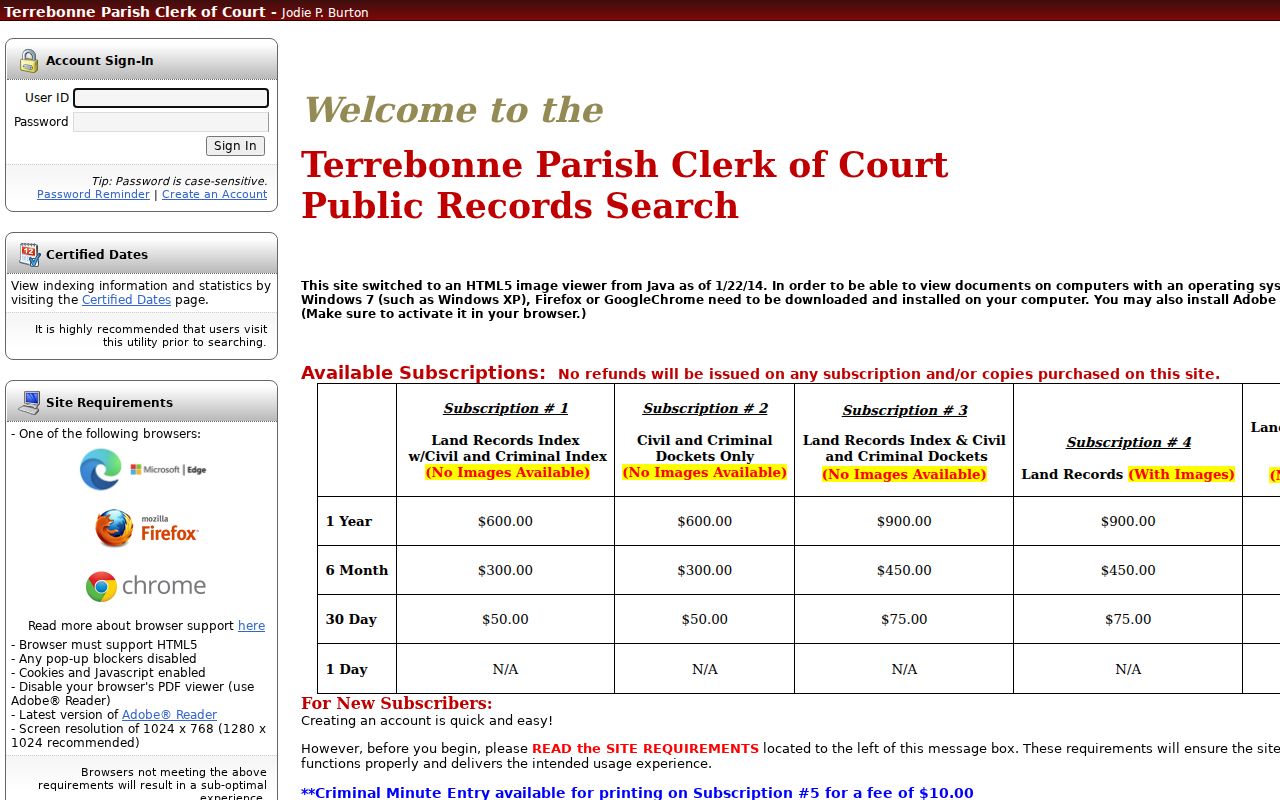
The login gate explains why a visible portal screen is not a complete public criminal case register.
Inside a Terrebonne Parish Criminal Docket
A Terrebonne Parish criminal docket lists entries in date order, and nothing more. It is an index, not a story about the case. Start at the header. You find the case number, court or division, judge, category, caption, and the opening or filing date there. Then work through the minutes in the order they were entered. A charge block may show a bill of information or indictment. That filing is only a charge. It is not a conviction. A later plea or trial is a different step. So is a sentencing, a dismissal, or some other disposition in the process. The docket may also carry bond or forfeiture references. Counsel or appearance information can appear too. So can a setting, an appeal notice, and a verification or restriction label.
| Case number | The court-assigned key; retain it exactly and pair it with the venue, such as criminal case number. |
|---|---|
| Case header | Division, judge, category, caption, charge or formal charging reference, and filing or indexed date. |
| Minute entry | The clerk’s condensed record of what occurred in court, including hearings, pleas, rulings, and settings where entered. |
| Setting | A scheduled appearance such as arraignment, motion, pretrial, status conference, trial, or sentencing; confirm it with the division. |
| Disposition | The recorded outcome or status. A formal copy may require a separate minute-entry or certified-copy request. |
Watch the dates. An index date can differ from the actual hearing or event date. Before asking the clerk for a minute entry or any document, write down the exact event text and its date.
Terrebonne Parish Criminal Docket Minutes
Criminal Processing sits at the center of the local record flow. The clerk states that criminal proceeding minutes are processed, docketed, and calendared there. A Terrebonne Parish criminal docket can therefore point to the minute entry. That entry is the record of a hearing. Before you request anything, stop. Ask whether you need a minute entry, a disposition, a judgment, or the complete file. The Criminal Records Department page identifies the department. It maintains felony, misdemeanor, traffic, criminal non-support, and juvenile files.
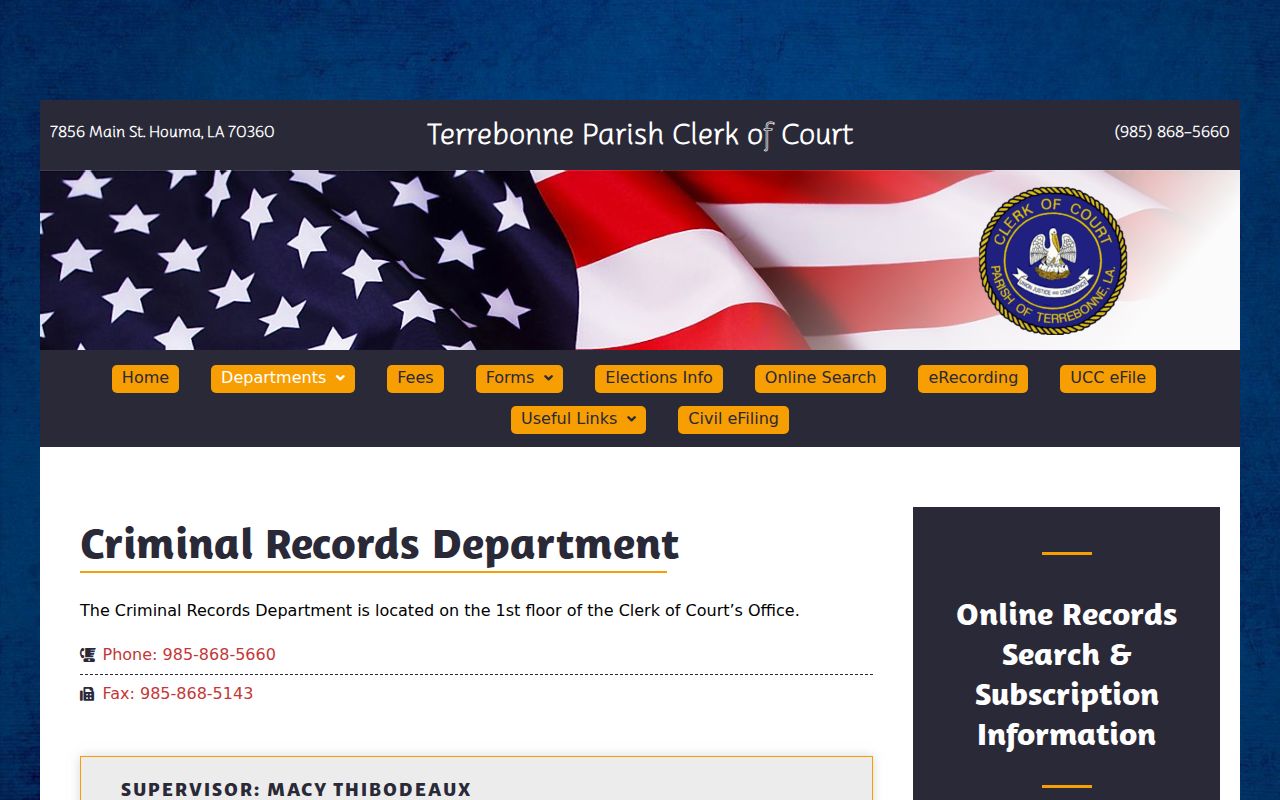
Know the venue and the record type before you ask. That much is clear from the categories themselves. A Terrebonne Parish criminal docket request works best when it names the court. It also helps to name the kind of filing you want. Minutes, calendars, and warrants live in different places. The Criminal Processing page from the clerk covers how the office handles minutes, criminal calendars, warrants, and related court events.
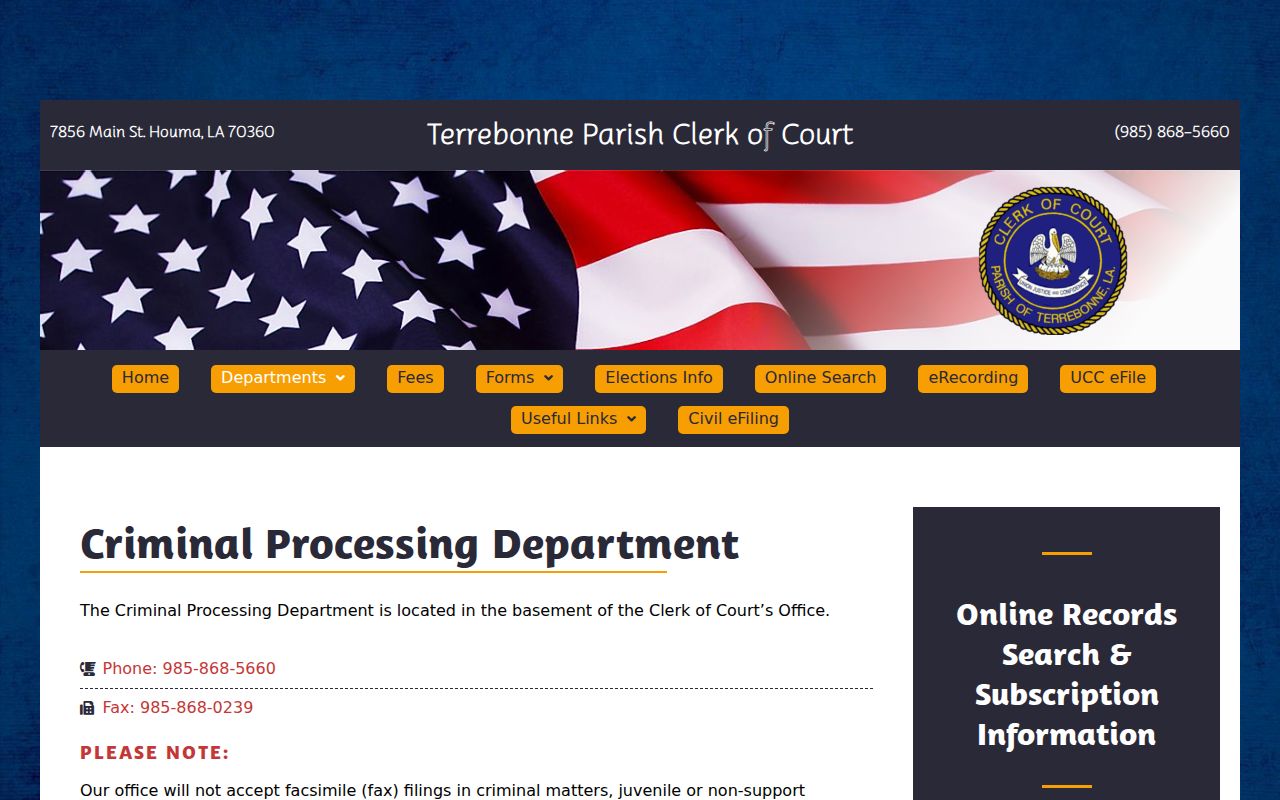
Records and processing are two different things. A name search may pull an older entry, but confirming a current hearing or minute entry can take a more specific request to the clerk who keeps the Terrebonne Parish criminal docket up to date.
How a Criminal Case Moves
Records and processing are two separate shops. That split explains why confirming a current minute or calendar often takes a more specific request than a simple name search.
Filing or formal charge → arraignment → pretrial or motion → plea or trial → disposition → sentencing or appeal.
Each term on a criminal docket does its own job. An arraignment brings the charge forward. It also starts the plea process. A motion is simply a written request asking the court to rule. Nolle prosequi should be read exactly as the docket enters it. It does not automatically mean another disposition happened. A notice of appeal opens a separate route. The clerk builds the trial record for the First Circuit from there.
Terrebonne Parish Criminal Docket Courts
The 32nd Judicial District Court runs Terrebonne Parish felony and district criminal work across five divisions, A through E. For those files, the Terrebonne Parish Clerk's Criminal Records and Criminal Processing departments are the offices to contact. Houma City Court sits apart from that system. Its criminal and traffic department takes city misdemeanor summonses and traffic tickets, so a city citation belongs at the city court rather than in a 32nd JDC criminal docket search. Juvenile matters call for extra care too. The clerk may maintain a juvenile file, but that does not make it an ordinary public adult record.
| Venue | Criminal docket role | Custodian or route |
|---|---|---|
| 32nd JDC, Divisions A-E | District criminal proceedings, including felony matters | Terrebonne Parish Clerk, Criminal Records and Criminal Processing |
| Houma City Court | City misdemeanor summonses and traffic matters | Houma City Court, 8046 Main Street |
| Juvenile jurisdiction | Juvenile matters as assigned by the responsible court | Responsible juvenile clerk, subject to confidentiality rules |
The 32nd JDC court source lays out the district-court structure. After you know the division, its judicial assistant is the best contact for confirming when and where a hearing is set.
Courts That Hold Criminal Dockets
Where you look for a Terrebonne Parish criminal docket depends on one thing. It depends on which court handled the case. At the clerk's complex, 7856 Main Street, Houma, Criminal Records sits on the first floor. Criminal Processing is in the basement. Call the main line at 985-868-5660 or fax the criminal department at 985-868-0239. Written requests can go to clerkofcourt@yahoo.com. You can also send them by mail. Include the case number, caption, the record type you need, and whether it must be certified. Older material requires an Archives pull, which you can request.
For a court date, call the assigned division. That office controls the setting. City cases belong to Houma City Court at 985-868-4232. Its misdemeanor and traffic department sits at 985-868-4361.
Terrebonne Parish Criminal Docket Channels
Online tools are only one way into a Terrebonne Parish criminal docket. Criminal Records and Criminal Processing can help in person. They also help by phone, or from a precise written request. The subscribed eSearch index tracks current cases and shows its coverage range. For older files, Archives is the fallback. Email and mail work for public-record requests. The assigned division confirms settings.
Houma City Court is the separate channel for city traffic and misdemeanor records. Its calendar endpoint sometimes goes down. The phone and the counter still matter. If access is denied or a case does not appear, narrow the question. Cover venue, case number, category, date range, and whether a seal or juvenile rule applies. Repeated broad searches will not lift a restriction.
Local distinction. A Terrebonne Parish criminal docket index can locate a case event, but the minute entry or certified copy is the clerk-held record to request when the exact court action matters.
Sealed Dockets and Public Access
Louisiana public-record law generally allows inspection and copying of court records. Still, a Terrebonne Parish criminal docket is not always open. Children's Code Article 412 keeps juvenile proceedings and reports confidential. Disclosure happens only along statutory paths. The clerk's Criminal Records Department maintains juvenile files. Yet that maintenance creates no public online visibility. A juvenile traffic violation may follow a different rule under the statute. The responsible clerk can identify which one applies.
Code of Criminal Procedure Article 973 makes an expunged arrest or conviction record confidential. The record is no longer public, subject to listed exceptions. A court seal, protected family content, or redacted identifiers can also block access. A Title 44 request cannot override a court order or juvenile confidentiality. Ask the clerk what is required. It may be a public docket entry, an authorization, a court order, or another formal route.
The official juvenile-confidentiality source states the rule that limits ordinary access to Terrebonne Parish criminal docket material involving juveniles.
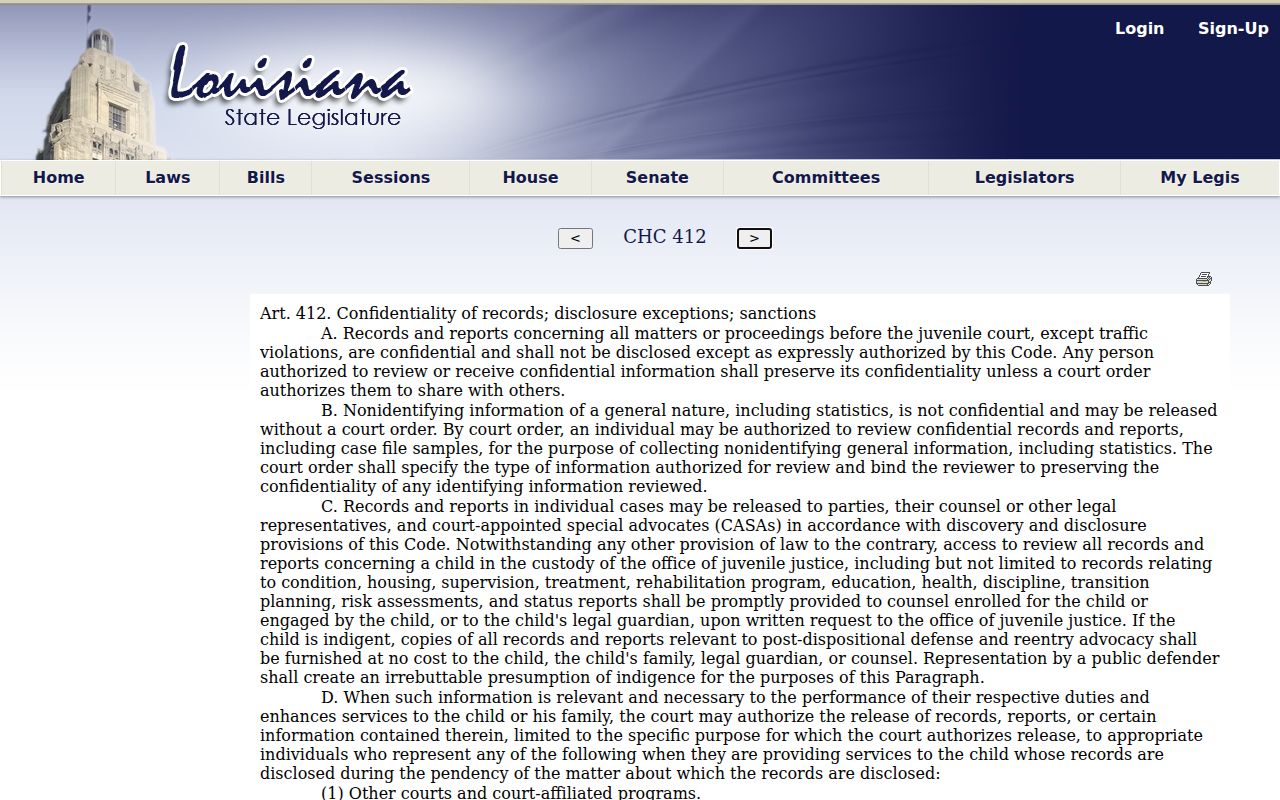
When a result comes back unavailable, confirm it with the court or clerk. A search screen alone cannot tell you why a record is closed.
Terrebonne Parish Criminal Docket Dispositions
A disposition is the recorded outcome or status of a charge. The clerk lists a criminal disposition at $10 per minute entry. You may only need the minute that records the result rather than a full case file. Say whether you want a minute entry, judgment, certified disposition, or another record. Confirm the department rate first.
Copy the exact local wording into your notes. Entries for a plea, judgment of forfeiture, dismissal, sentence, capias or bench warrant, or appeal each carry a procedural meaning. That meaning depends on the docket and minute. A Terrebonne Parish criminal docket gives you the event trail. The originating court or clerk remains the source. Confirm any record there before you rely on it.